
Mold needs moisture, something organic to eat, and a couple of days. A roof leak supplies all three, which is why roof leak repair in Bixby is something we treat as same-day work. Wet insulation and wet plywood in a dark attic are close to ideal conditions, and the general rule with water intrusion is that mold can start establishing itself within about 24 to 48 hours of the material getting wet and staying wet.
The reason we push that hard has almost nothing to do with the roof. The roof itself is one repair. What sits underneath it getting soaked is the expensive part.
What a small leak does, roughly week by week
This is not a lab measurement, it is the pattern we see on houses. Timing shifts with how much water, how humid it is, and how well your attic breathes.
The first day or two. Water gets through, runs down the decking, and lands in the insulation. Nothing is visible from inside. The insulation is doing exactly the wrong thing: holding the water against the wood instead of letting it dry.
Days two through seven. Wet fiberglass or blown insulation loses most of its R-value while it is damp, so your heating and cooling starts working harder in that part of the house. Mold begins establishing on the paper facing and the underside of the decking. You still may not see anything.
Week two to a month. The stain shows up on your ceiling. This is the point most people call us, and it is already the late stage of the timeline. The plywood has been wet through several cycles. Drywall is soft where the water pooled. If the leak found a rafter, there is staining down the wood.
Two months and beyond. Decking starts to delaminate, which is when the plywood layers separate and the sheet goes spongy. That sheet now has to be replaced, which means the repair is no longer a shingle job. Drywall may need cutting out. Depending on how much mold established and where, you may want a remediation specialist involved, which is a separate trade from roofing and we will tell you honestly when you have crossed into that.
The gap between "call in week one" and "call in month three" is usually the gap between a couple of hours of roof work and a project involving three trades.
Why the leak was there in the first place
On Bixby roofs, the usual suspects are boring and repeatable:
A cracked pipe boot. The rubber collar around a plumbing vent. Oklahoma sun destroys rubber. These fail constantly and they are cheap to replace.
Flashing that has lifted or lost its seal. Around chimneys, skylights, and where a roof plane meets a wall. Our most common find.
Wind-broken shingle seals. A shingle that got lifted once no longer lies flat, and it is a flap from then on.
Hail bruising. The nastiest one, because a hail-bruised shingle looks fine. The mat is cracked under the granules and it lets water through months or years later.
Nail pops. A nail backs out slightly and pushes up through the shingle above it. Small hole, plenty of water.
None of those are dramatic. All of them will soak your attic for as long as you let them.
Why you cannot judge the size of the leak by the size of the stain
A one-inch stain on the ceiling is not a one-inch problem. Water spreads out through insulation and travels along framing, so the wet footprint in your attic is usually far bigger than the mark you see downstairs. We have opened up attics where the ceiling showed a spot the size of a coffee cup and the insulation was matted flat across four joist bays.
Which is also why patching above the stain does not work. You have to find the actual source, which is uphill from the stain, sometimes a long way uphill.
What we do when we get there
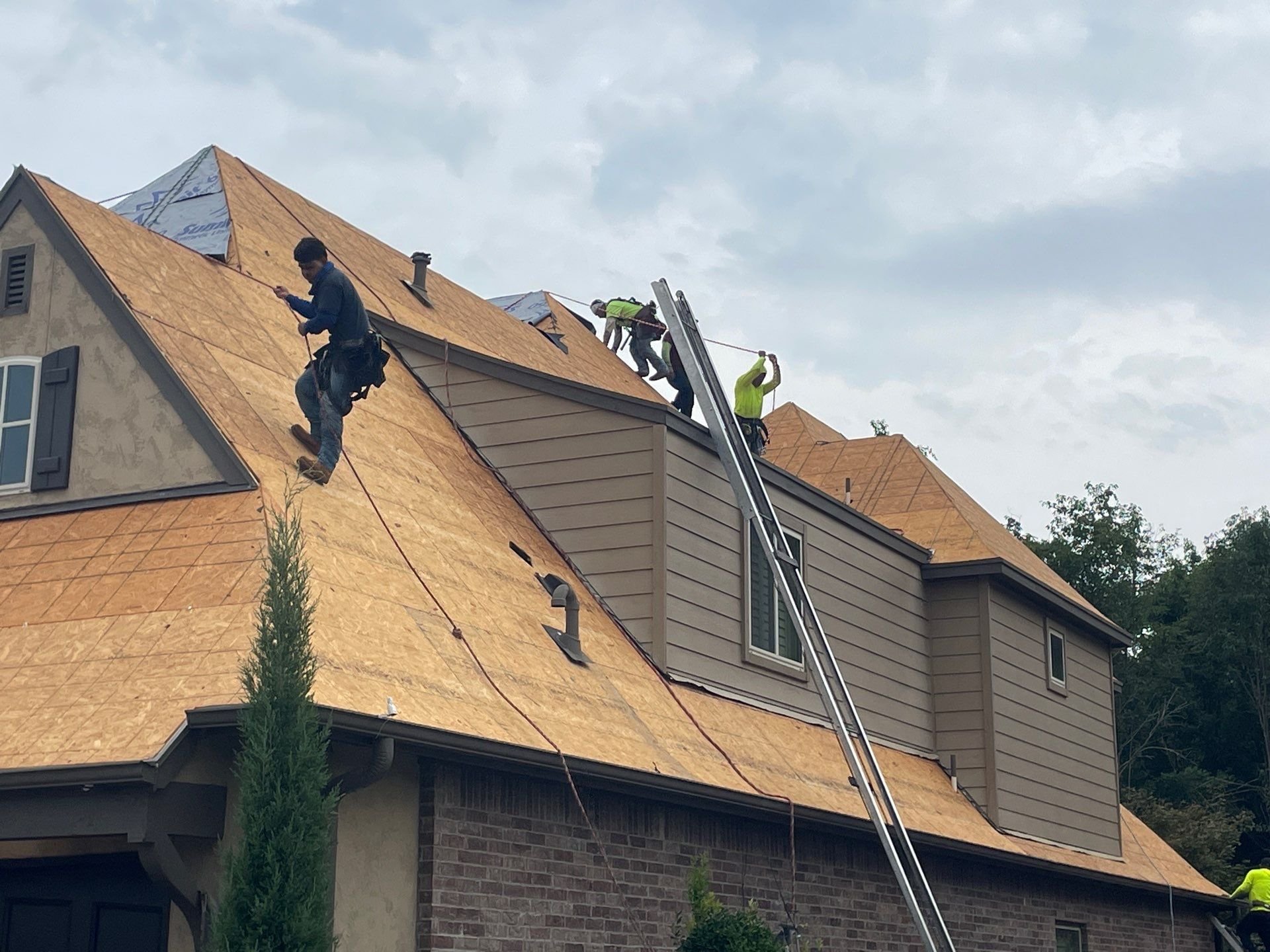
We walk the roof and work backward from the spot above your stain, checking shingles, flashing, boots, and valleys until we find the entry point. Then, when there is attic access, we go up and look at the decking from underneath, because that tells us how long this has been happening and how far the water spread. If any decking has gone soft, you will see photos of it.
Most of the time the roof-side fix is one visit. What we will also tell you, plainly, is whether the wet insulation needs to come out and whether what we saw in the attic warrants bringing in someone who does remediation. We would rather hand you a slightly bigger picture than fix the shingle and leave you with a wet attic.
For the full rundown of what we check, here is what an inspection covers.
If it is dripping right now
Do not read the rest of this. Get a bucket under it, move anything water can ruin, take photos, and call. If you want the full order of operations, here are the first five things to do when you find a leak.
Book the inspection while it is still cheap
If you have a stain, a musty smell in an upstairs room, or a leak you have been meaning to deal with since the last storm, get it looked at now rather than in the spring. Book a free roof inspection and we will find the source, show you what the attic looks like, and give you a straight answer on the fix.
Call (918) 604-2039 or book online. We work around Bixby and across Green Country, we are locally owned, and every repair carries a lifetime workmanship guarantee.
Frequently asked questions
How long does it take for a roof leak to cause mold? With water intrusion generally, mold can begin establishing within about 24 to 48 hours on wet organic material. An attic is a good environment for it: dark, poorly ventilated, and full of paper facing and plywood. By the time a stain appears on your ceiling, the material above it has usually been wet for a while.
Is a small roof leak actually urgent? Yes, more than the size suggests. The cost of a leak is rarely the roof repair. It is the wet insulation, the softened decking, the drywall, and anything mold-related, and all of those get worse the longer the water keeps coming.
Does homeowners insurance cover mold from a roof leak? It varies a lot by policy, and many policies limit or exclude mold, particularly when the leak went unaddressed for a long time. Carriers tend to look at whether the homeowner acted once the problem was known. Photograph everything from the day you notice it and check your policy language, or ask your agent.
Can I just dry out the attic myself and skip the repair? Drying helps, but it does not fix anything, because the next rain puts the water right back. Stop the source first. And if the insulation is saturated, it usually needs to come out rather than dry in place.
Do you handle mold remediation? No. We are roofers. We stop the water and replace the roof-side damage, including decking, and we will tell you clearly if what we find in your attic needs a remediation specialist. We would rather point you to the right trade than pretend the problem is only the roof.
Why does my upstairs smell musty when I cannot see any water? That is worth an inspection. A musty smell with no visible stain often means moisture in the insulation or decking that has not yet worked through to the drywall, which is actually the good version of this problem because you caught it early.